

One membrane platform, from dilute feed to 280,000 mg/L
Three proprietary reverse-osmosis processes, each designed for its own salinity range. Together they carry a stream to crystallizer-ready concentration on standard membrane equipment, without an evaporator in the middle.
- Concentration ceiling
- 280,000mg/L
- Brine concentration energy
- 5–12kWh/m³
- Conventional RO concentration limit
- 3×
Operating ranges
Each process covers its own salinity range, and the ranges overlap, so a stream is concentrated from feed to crystallization without an intermediate thermal step.
mg/L TDS
| Lane | Range | From (mg/L TDS) | To (mg/L TDS) | Note |
|---|---|---|---|---|
| SEBRO | SEBRO | 0 | 25,000 | Dilute brines |
| SAMRO | SAMRO | 20,000 | 90,000 | Mid-range, adaptive |
| MBC | MemBrine Concentrator | 90,000 | 280,000 | 5–12 kWh/m³ |
| Crystallizer | Crystallization | 280,000 | 300,000 | The residue only |
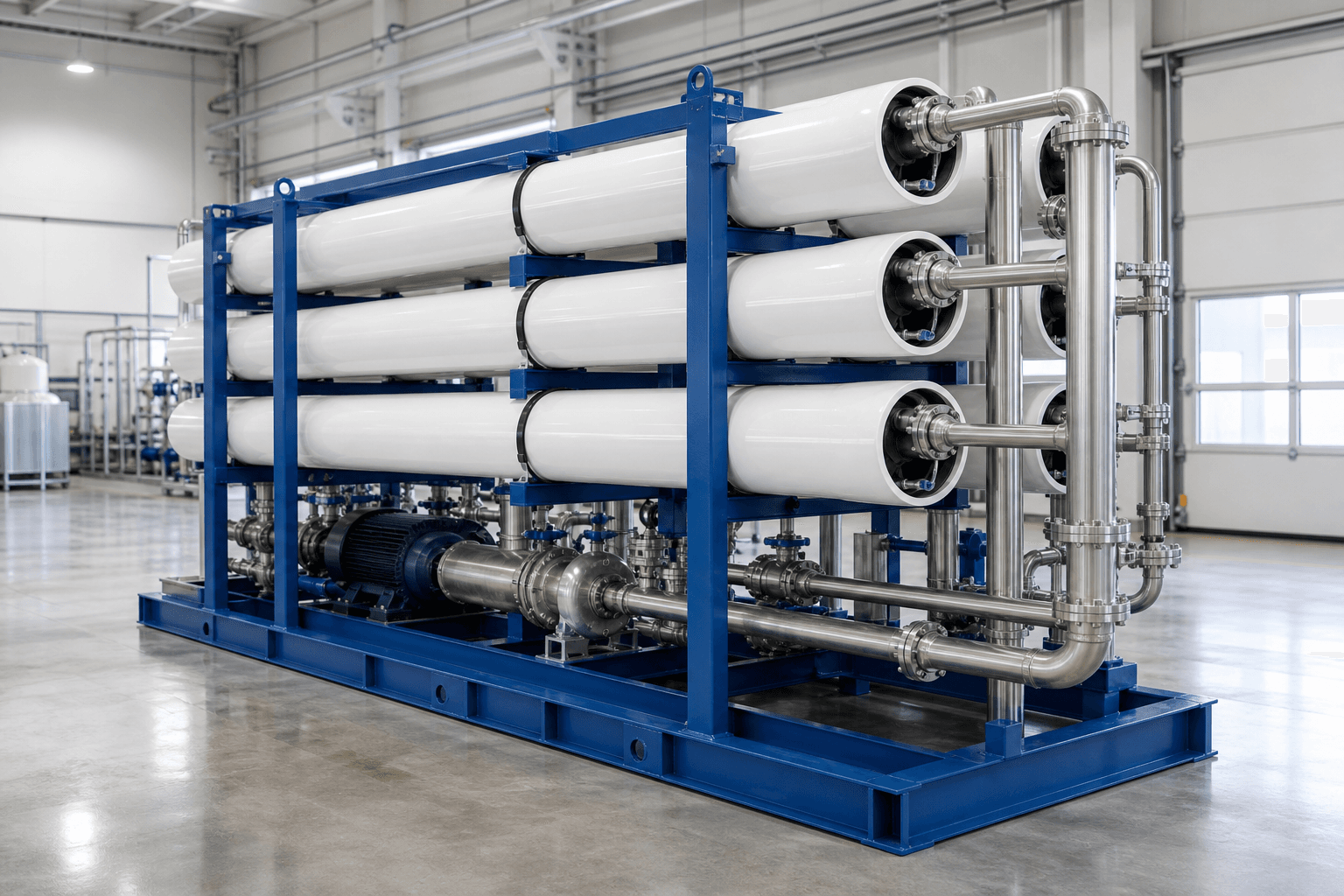
MemBrine Concentrator™
Brine concentration beyond the limit of reverse osmosis
Conventional RO stops at about 90,000 mg/L. The MemBrine Concentrator continues to 220,000–280,000 mg/L at 5–12 kWh/m³, the duty that has otherwise required thermal evaporation at 25–60 kWh/m³. It is the core of most Osmosys trains.
- Feed
- from 90,000 mg/L
- Concentrate
- 220,000–280,000 mg/L
- Specific energy
- 5–12 kWh/m³
- Equipment
- Standard RO membranes and pressure vessels
Replaces thermal duty
Up to 5× lower energy than evaporation on the same concentration step.Crystallizer-ready
Concentrate strong enough that the crystallizer handles the residue only.DLE-compatible
Concentrates lithium eluate from any direct-extraction chemistry.
Salinity-Adaptive Multi-step Reverse Osmosis
High-recovery desalination that adapts to the feed
SAMRO adjusts its operating point to the incoming salinity, including fouling-prone and chemically difficult waters, across 20,000–90,000 mg/L. On seawater it uses 0.48 kWh/m³, against 1.36 for standard RO. In most trains it prepares the feed for the MemBrine Concentrator.
- Feed range
- 20,000–90,000 mg/L
- Specific energy
- 0.48 kWh/m³ on seawater
- Permeate
- Two streams, high and standard quality
- Equipment
- Standard RO membranes and pressure vessels
Specific energy on seawater
The same seawater feed, by configuration.
kWh/m³ permeate
| Configuration | kWh/m³ |
|---|---|
| SAMRO | 0.48 |
| Batch RO + HP tank | 0.55 |
| Batch RO + PX | 0.57 |
| CCRO | 0.82 |
| RO + PX | 1.24 |
| Standard RO | 1.36 |
Adaptive operation
Operating point follows feed salinity automatically.No interstage boosting
A simpler pumping arrangement than multi-stage RO.Single-stage concentration
100,000 mg/L in one stage at King Salman Park.
Semi-Batch Reverse Osmosis
Low-energy recovery from dilute feeds
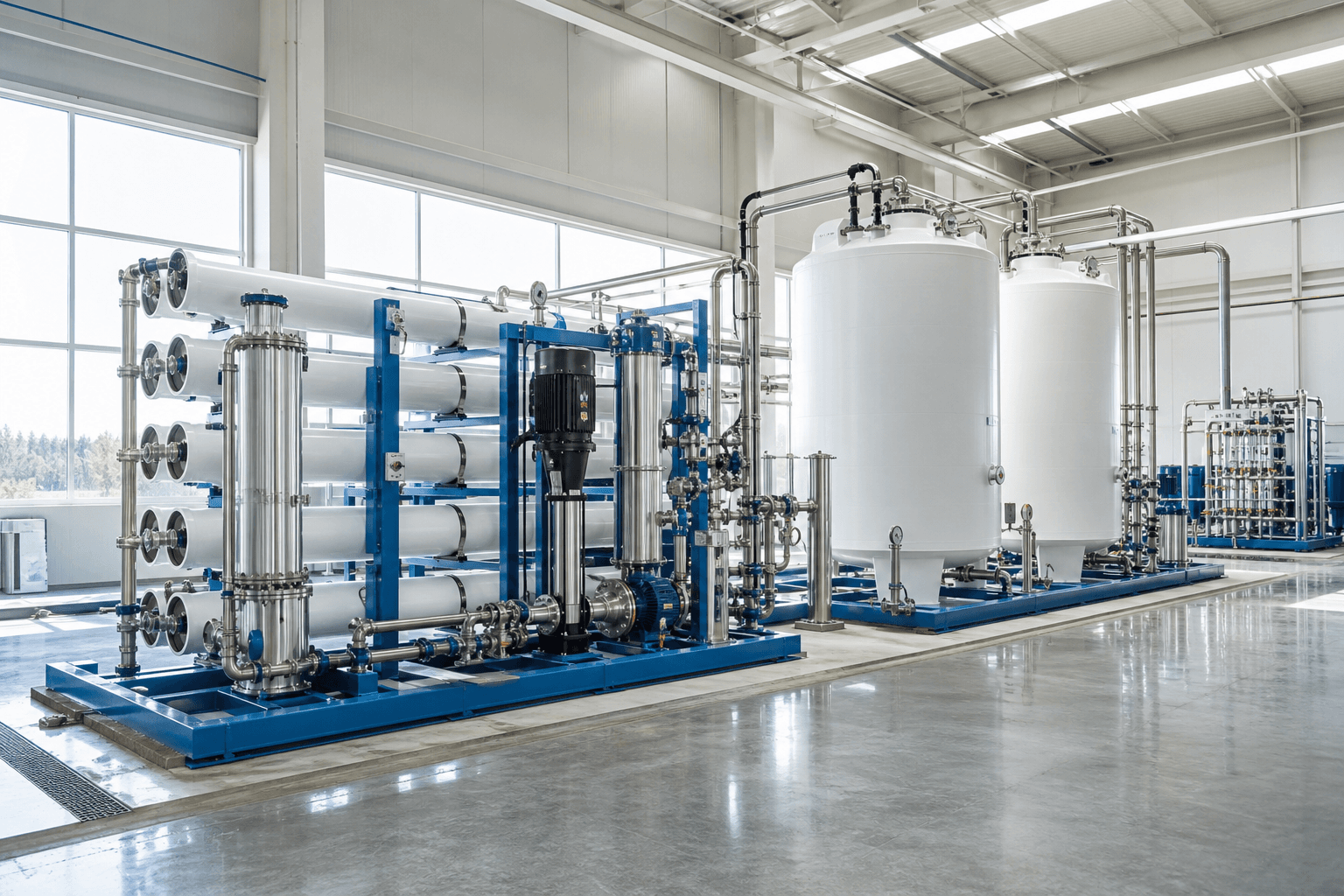
SEBRO treats brackish water, treated effluent, and other feeds up to 25,000 mg/L. Cyclic semi-batch operation follows the feed's rising osmotic pressure, recovering most of the water at low specific energy and delivering a stable concentrate to SAMRO.
- Feed range
- up to 25,000 mg/L
- Operation
- Cyclic semi-batch
- Position
- First stage on dilute feeds
- Equipment
- Standard RO membranes and pressure vessels
Semi-batch pressurization
Pressure follows the feed, rather than sizing for the worst case.Fouling resistance
Time-variant flux and pressure across the membrane.Stable hand-off
Delivers a consistent feed within the SAMRO envelope.
Specific energy by route
Energy is the largest operating cost in brine concentration. Per cubic metre of water removed, membrane concentration uses 5–12 kWh; thermal routes use 15–60.
Specific energy by route, per cubic metre of water removed.
kWh/m³ of water removed
| Route | Duty | Specific energy (kWh/m³) |
|---|---|---|
| Conventional RO | to 90,000 mg/L | 2.7–4 |
| MemBrine Concentrator | 90,000–280,000 mg/L | 5–12 |
| Mechanical vapor compression | the first thermal step | 15–20 |
| Thermal brine concentration | the evaporator | 20–30 |
| Crystallization | the finish, on the whole flow | 35–60 |
Platform specification
Published operating envelopes. Project figures are set by the design basis for each feed.
Discuss a project
Share the flow rate, water analysis, and treatment objective. Our process engineering team will follow up.