

Solutions
Lower produced water disposal volumes
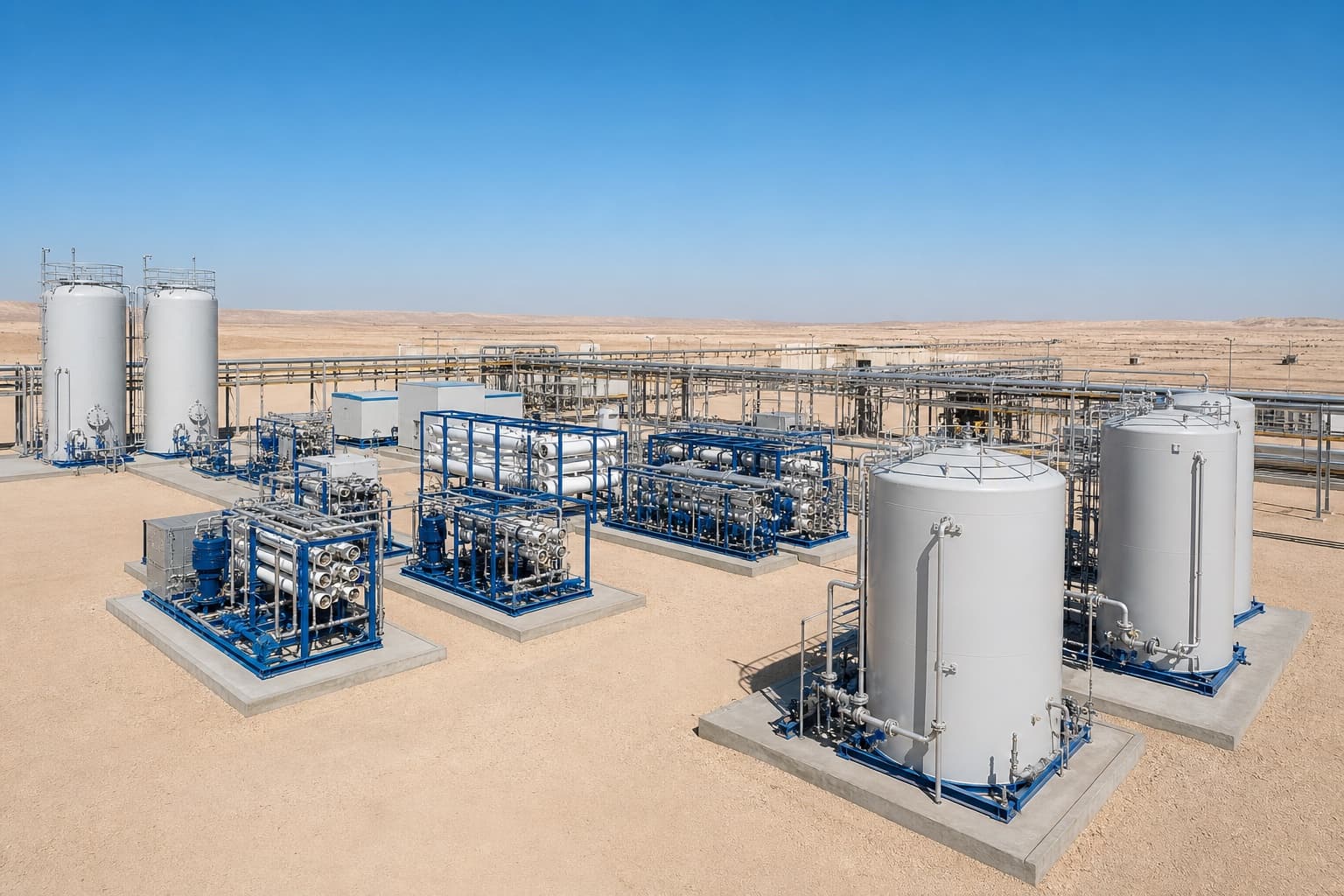
Every barrel of oil is produced with three to seven barrels of water, most of it trucked, piped, or injected for disposal. Osmosys concentrates the stream and returns clean water to the operation.
- Water produced per barrel of oil
- 3–7bbl
- Membrane concentration ceiling
- 280,000mg/L
- Specific energy, against 25–60 thermal
- 5–12kWh/m³
The challenge
Produced water costs scale with volume, and the volume does not decline on its own. The same operators that pay for disposal often buy fresh water for drilling and completions.
Transport
Trucking is the dominant cost on leases without water pipelines.Injection capacity
Disposal wells are constrained, increasingly by seismicity regulation.Fresh water
Operations pay again to source water for drilling and completions.
Approach
The produced water train
Oil and antiscalant are removed first, saleable minerals are taken off the brine, and the MemBrine Concentrator concentrates the remainder. Only the residue goes to disposal or a crystallizer.
Typical configuration. Stream values for each project are set by pilot testing.
- 01Produced water50,000–250,000 mg/L TDS
- 02Pretreated feedoil and antiscalant removed
- 03Extracted brineBr₂ · I₂ · SrSO₄ · BaSO₄ taken off
- 04MBC concentrate200,000–280,000 mg/L
- 05Recovered waterreuse, injection, or cooling
- 06Industrial saltsNaCl and CaCl₂
| Stream | Name | Detail |
|---|---|---|
| 1 | Produced water | 50,000–250,000 mg/L TDS |
| 2 | Pretreated feed | oil and antiscalant removed |
| 3 | Extracted brine | Br₂ · I₂ · SrSO₄ · BaSO₄ taken off |
| 4 | MBC concentrate | 200,000–280,000 mg/L |
| 5 | Recovered water | reuse, injection, or cooling |
| 6 | Industrial salts | NaCl and CaCl₂ |
Where the economics work
The benchmark is the lowest-cost disposal route available to the site. A feed analysis establishes the fit before any capital is committed.
What it delivers
Disposal volume
A concentrate that is a fraction of the original volume.Water for reuse
Recovered water for drilling, completions, injection, or cooling.Mineral revenue
Bromine, iodine, strontium and barium salts recovered where the brine supports it.Pilot-backed design
Performance guarantees are based on a pilot on the operator's own water.
Discuss a project
Share the flow rate, water analysis, and treatment objective. Our process engineering team will follow up.