

Case study
King Salman Park: zero liquid discharge at municipal scale
Turning 10,800 m³ a day of reject brine into irrigation water for the world’s largest urban park, with near-zero liquid discharge, from an underground plant 70% smaller than a conventional system.
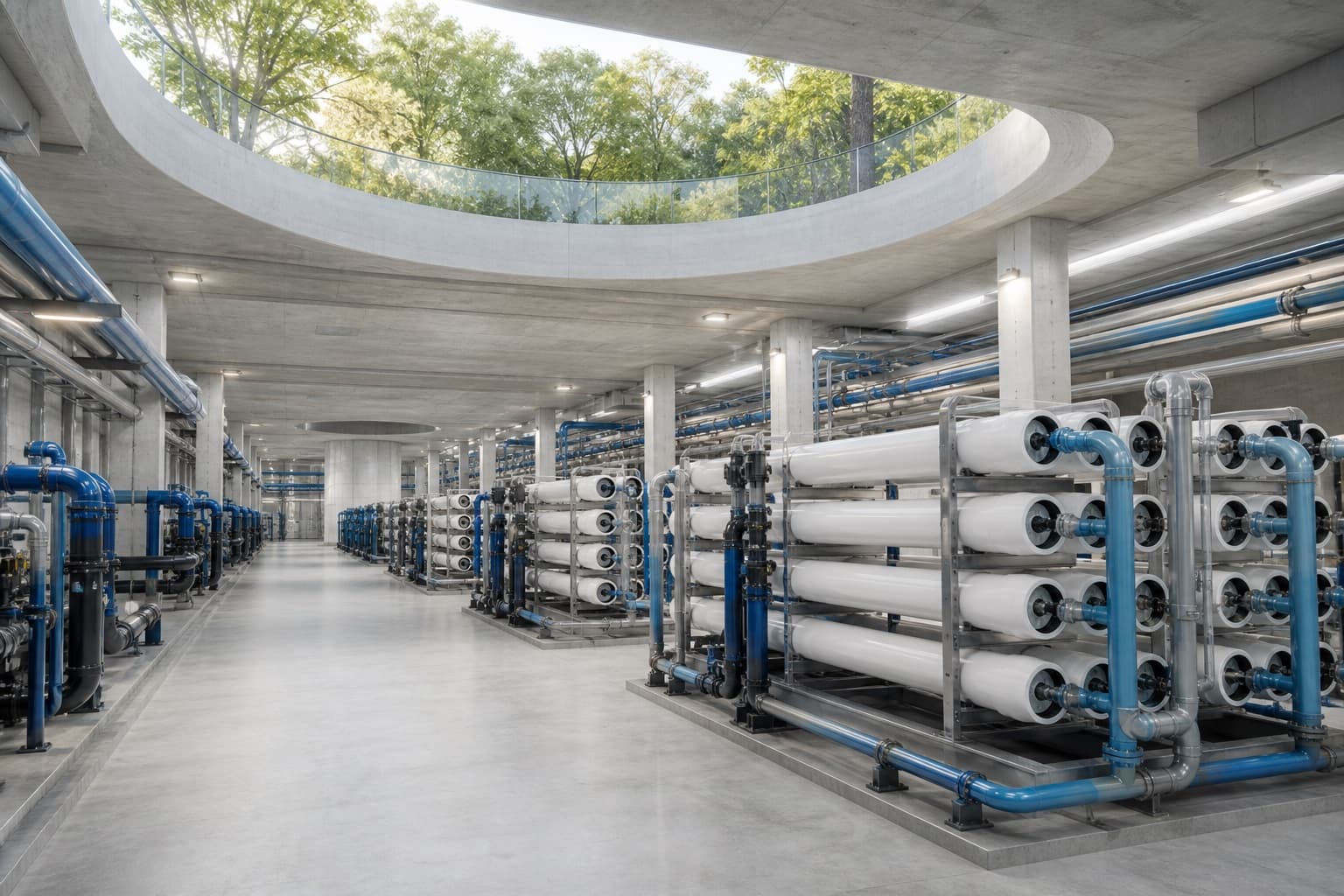
- Brine treated
- 10,800m³/day
- Reject brine from the park’s effluent treatment
- Water recovery
- 82%
- Returned to the park as irrigation water
- Smaller footprint
- 70%
- Compared with a conventional system
- Energy reduction
- 50%
- Compared with a thermal train on the same duty
Project
Client
Wetico & Albawani Joint Venture (WBJV)Location
King Salman Park, Riyadh, Saudi ArabiaTechnology
SAMRO, MBCStatus
In execution
The challenge
King Salman Park, a 16 km² development in Riyadh, is designed as the largest urban park in the world. Its treated sewage effluent system generates 10,800 m³/day of reject brine at approximately 36,772 mg/L TDS, which must be treated to irrigation quality with near-zero liquid discharge in an underground facility.
Variable chemistry
Calcium 1,414 mg/L, magnesium 1,211 mg/L, chloride 15,867 mg/L, with BOD 400 mg/L and COD 800 mg/L.Irrigation quality
Consistent product water quality for the park's irrigation network.Near-zero discharge
Near-zero liquid discharge from a brine that is already concentrated.Underground plant
Compact footprint for installation below the park.
The solution
Osmosys, with Power Line Solutions, is delivering an integrated treatment train for the Wetico & Albawani Joint Venture: pretreatment, single-stage SAMRO concentration to 100,000 mg/L TDS, and MemBrine Concentrator concentration to more than 200,000 mg/L TDS ahead of crystallization.
Osmosys membrane scope
Reject brine
36,772 mg/L TDS 10,800 m³/day
Pretreatment
Screening · clarifier APO · ultrafiltration
SAMRO
Adaptive HP pump · loop → 100,000 mg/L
MBC
Brine concentrator → 200,000+ mg/L
Crystallization
Residue to solids
Recovered water
82% of feed to park irrigation
Solid salts
By-product
- 01Reject brine36,772 mg/L TDS · 10,800 m³/day
- 02Pretreated brinesuspended solids and organics removed
- 03SAMRO concentrate100,000 mg/L · single stage, energy recovery
- 04MBC concentrate200,000+ mg/L · high-osmotic-pressure membranes
- 05Recovered water82% of feed, irrigation grade
- 06Solid saltscrystallizer by-product
| Stream | Name | Detail |
|---|---|---|
| 1 | Reject brine | 36,772 mg/L TDS · 10,800 m³/day |
| 2 | Pretreated brine | suspended solids and organics removed |
| 3 | SAMRO concentrate | 100,000 mg/L · single stage, energy recovery |
| 4 | MBC concentrate | 200,000+ mg/L · high-osmotic-pressure membranes |
| 5 | Recovered water | 82% of feed, irrigation grade |
| 6 | Solid salts | crystallizer by-product |
Results
Pilot testing on the actual feed established the recovery, energy, and footprint figures on which the commercial design is based.
82% water recovery
Irrigation-grade water returned to the park.50% lower energy
Specific energy against a thermal train on the same duty.70% smaller footprint
Compared with a conventional system, enabling underground installation.Adaptive control
Feed variation absorbed by SAMRO process controls.
Discuss a project
Share the flow rate, water analysis, and treatment objective. Our process engineering team will follow up.